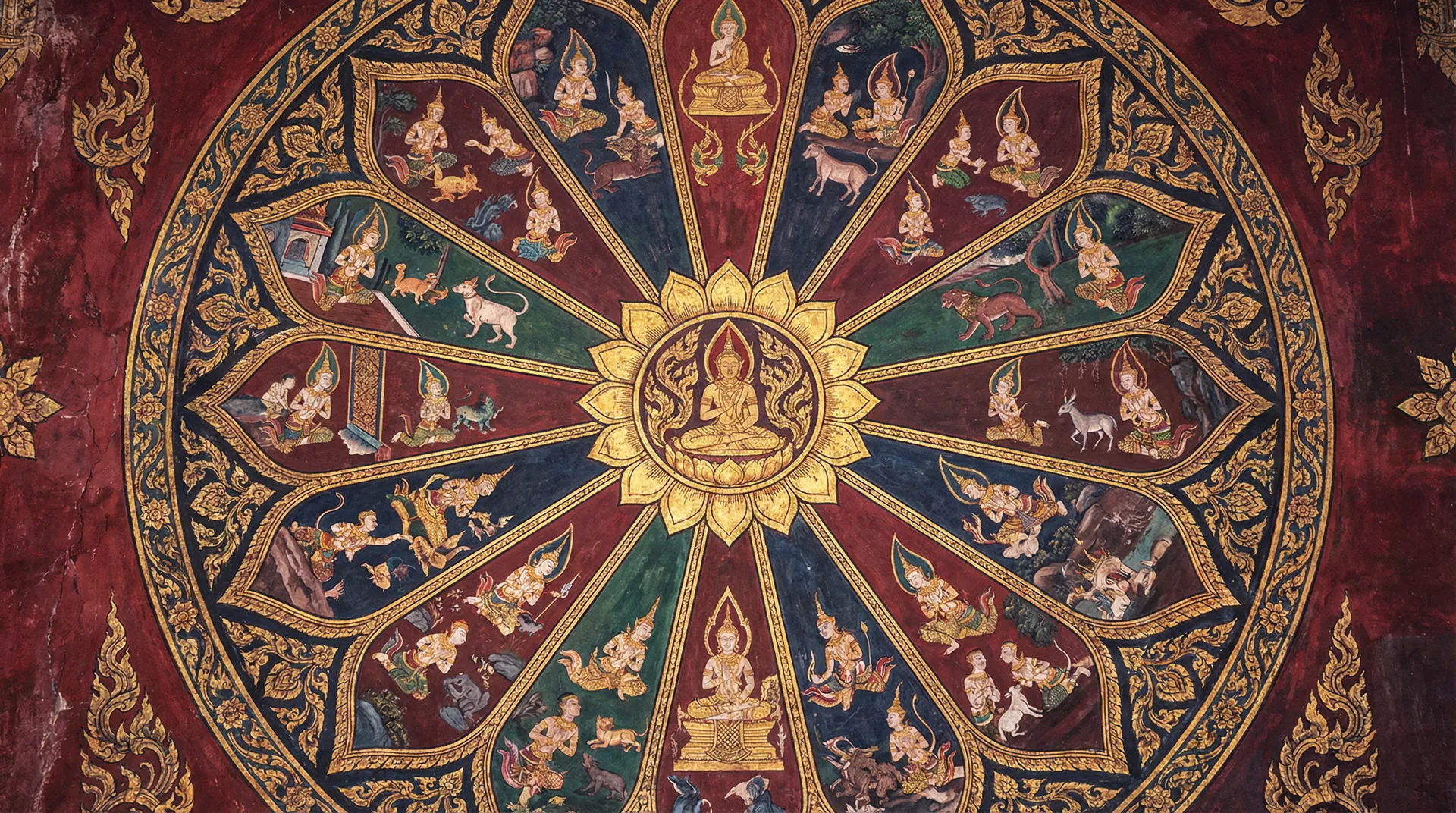
Mahosadha Jātaka
Mahosadha Jātaka
In the magnificent city of Mithila, capital of the Videha kingdom, ruled a wise and just king named Vedeha. However, even the wisest of rulers can be ensnared by cunning and deceit, and King Vedeha was no exception. His court was a hive of activity, filled with advisors, courtiers, and supplicants, among whom a constant undercurrent of ambition and rivalry flowed.
Among the king's retinue was a young man of extraordinary intellect and foresight, named Mahosadha. Even in his youth, Mahosadha possessed a mind that could unravel the most complex problems, foresee the consequences of actions, and devise solutions that were both ingenious and just. He was not driven by personal ambition, but by a deep-seated desire to see justice prevail and his kingdom prosper.
One of Mahosadha's most formidable challenges came in the form of a dispute that threatened to plunge the kingdom into chaos. A wealthy merchant claimed that a valuable jewel, entrusted to him for safekeeping, had been stolen. He accused his own servant, a young man named Pukkusa, of the theft. Pukkusa vehemently denied the accusation, claiming the merchant had misplaced the jewel and was falsely accusing him to cover his own negligence. The evidence was circumstantial, and both parties presented compelling arguments.
The king, unable to discern the truth, was presented with the case. His advisors were divided. Some believed the merchant, swayed by his wealth and influence. Others sided with Pukkusa, convinced of his honesty. The king, perplexed, turned to Mahosadha, who had been quietly observing the proceedings.
Mahosadha, with a calm demeanor, requested that the court be adjourned for a day. He then summoned both the merchant and Pukkusa to his private chambers. He spoke to them, not with accusations, but with gentle inquiries. He asked the merchant about the exact details of the jewel's safekeeping, its description, and the circumstances under which it was supposedly stolen. He listened intently to Pukkusa, asking about his movements and his interactions with the merchant.
The next day, Mahosadha presented his findings to the king and the court. He explained that the merchant, in his eagerness to portray himself as a trustworthy guardian of valuable items, had embellished the story. "Your Majesty," Mahosadha announced, "the merchant claims the jewel was entrusted to him, yet he cannot provide a detailed description of its setting or its unique markings. He speaks of it being stolen from a locked chest, but the lock itself shows no signs of tampering. Furthermore," Mahosadha continued, turning to the merchant, "you claim it was a single, large diamond, yet when I inquired privately, you described it as a sapphire."
The merchant, caught in his web of lies, stammered and paled. Mahosadha then revealed the truth: the merchant, having carelessly lost the jewel, had concocted the story of theft to avoid shame and financial ruin. He had intended to frame Pukkusa, who, by chance, had been present in the merchant's house around the time the jewel went missing. "The jewel was not stolen, Your Majesty," Mahosadha concluded. "It was misplaced by the merchant himself. Pukkusa is innocent."
The king, impressed by Mahosadha's astute deduction, declared Pukkusa innocent and ordered the merchant to confess his deceit. The court was astounded by Mahosadha's ability to uncover the truth through careful observation and logical reasoning.
Another time, a dispute arose between two neighboring villages over the ownership of a seemingly fertile piece of land. Both villages claimed ancestral rights to the territory. The king, again in a quandary, referred the matter to Mahosadha. Mahosadha, instead of immediately taking sides, proposed a test. He suggested that both villages cultivate the land for one planting season. The village that produced the most abundant harvest would be declared the rightful owner.
The villagers, eager to prove their claim, agreed. Mahosadha, however, secretly instructed a trusted group of farmers to work on the land during the night, carefully tending to the soil and ensuring optimal conditions, but only after the villagers had completed their day's work. He wanted to observe the villagers' true commitment and their understanding of agriculture.
At harvest time, the results were astonishing. The land, thanks to Mahosadha's clandestine efforts, yielded a crop far richer than anyone had anticipated. The villagers were jubilant, each claiming the bounty as their own. But Mahosadha then revealed his actions. He explained that the extraordinary yield was a result of careful, continuous cultivation, not just by the villagers, but by his own team. He then pointed out that one village had meticulously weeded and fertilized their plots daily, showing true dedication, while the other had done so only sporadically. Based on this demonstration of consistent effort and understanding of the land, Mahosadha declared the village that had shown consistent dedication as the rightful owner. He argued that true ownership was not just about claim, but about responsible stewardship and diligent care.
Mahosadha's wisdom was not confined to resolving disputes. He advised King Vedeha on matters of state, predicting famines, recommending irrigation projects, and fostering peace with neighboring kingdoms through clever diplomacy. He was a beacon of intelligence and integrity in the court of Mithila, always acting for the greater good, his mind a sharp instrument cutting through deception and confusion, revealing the clear path of truth and justice.
— In-Article Ad —
💡Moral of the Story
Intelligence, foresight, and a commitment to truth are essential for effective leadership and for resolving complex disputes. True ownership and right are earned through diligent effort and responsible stewardship.
Perfection: Wisdom (Prajna)
— Ad Space (728x90) —
More Jataka Tales You May Enjoy
 251Tikanipāta
Nandiya-Jātaka
Nandiya-JātakaIn the heart of a lush forest, where ancient trees whispered secrets to the wind and s...
💡 True fulfillment and lasting happiness are found not in worldly possessions or power, but in detachment, simplicity, and the pursuit of spiritual enlightenment. The greatest leadership is often demonstrated through selfless sacrifice and the courage to follow one's highest calling.
 348Catukkanipāta
Dhammapāla Jātaka
The Bodhisatta as a Serpent Guardian JātakaIn the heart of a sun-drenched forest, where ancient tree...
💡 True power comes from selfless compassion and spiritual devotion, capable of overcoming even the most severe challenges and restoring life and balance.
 191Dukanipāta
Kaccapajataka
Kaccapajataka In the ancient kingdom of Mithila, where palaces shimmered like lotus blossoms and riv...
💡 True wealth lies not in what we possess, but in our ability to be content with what we have. Greed is a bottomless pit that can never be filled.
265TikanipātaMahapothada Jataka
Mahapothada JatakaIn the ancient kingdom of Videha, nestled amidst fertile plains and rolling hills,...
💡 Unwavering patience and profound compassion have the power to transform even the most hardened individuals. True strength lies not in violence, but in empathy and the courage to offer understanding.
279TikanipātaAssaka Jataka
The Tale of the Noble Prince and the Impatient Camel In a kingdom renowned for its lush landscapes a...
💡 Impatience leads to folly and suffering. True strength lies in patience, understanding the limits of oneself and others, and respecting the journey, not just the destination.
269TikanipātaKacchapa Jataka
Kacchapa JatakaIn the ancient kingdom of Savatthi, nestled amidst rolling hills and fertile plains, ...
💡 True peace and contentment arise from accepting the impermanence of all things and acting with diligence but without attachment to outcomes.
— Multiplex Ad —